
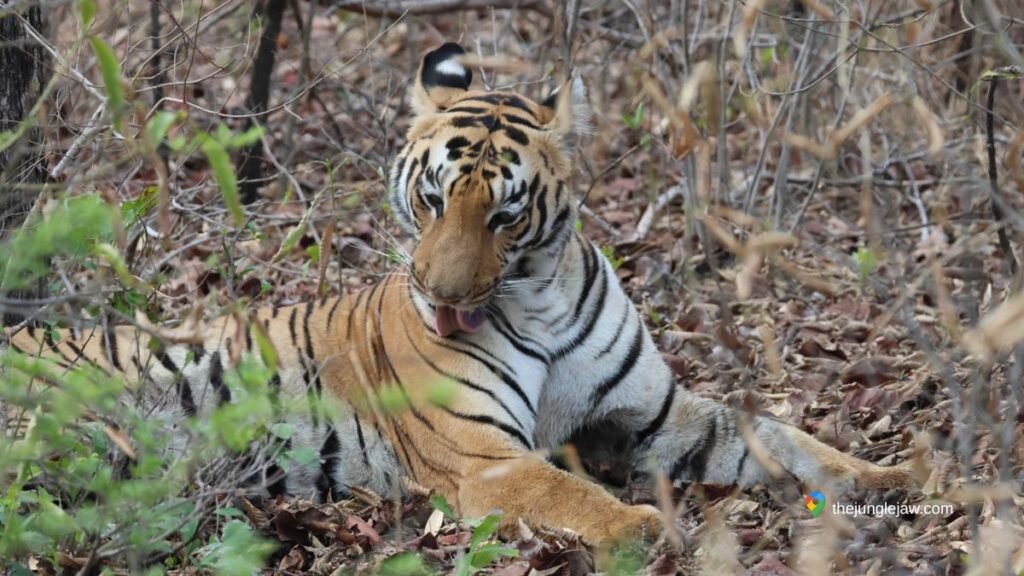
Most people assume a tiger’s stripes are only on its fur — I would have too, before I started digging through a real tiger census report for this piece. The truth is stranger and, honestly, a bit better than that assumption — tiger stripes on skin are just as real as the ones on the coat above them. A tiger isn’t wearing a striped jacket. It’s striped all the way down. And that one weird biological fact is quietly the reason we can count individual wild tigers at all — which is how we know that a reserve in Maharashtra went from a single lonely male tiger in 2011 to ten named, tracked individuals by 202
Table of Contents
Myth or Fact, Settled
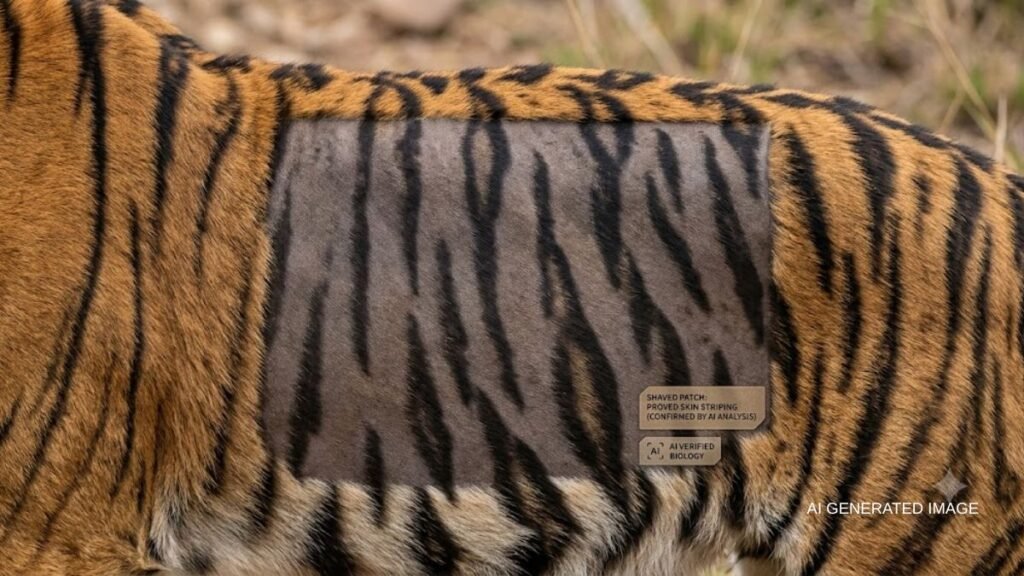
It’s a myth. The statement “tiger stripes are only on the fur” is the wrong answer, and it’s wrong in a genuinely interesting way. Tiger stripes on skin exist independently of whatever’s happening with the fur — same pattern, same placement, just underneath. That’s not a fun-fact footnote either. It’s the entire reason field biologists trust stripes, and nothing else, when they need to tell one wild tiger apart from another.
Okay, But How Does That Actually Work?
Here’s the part that surprised me. A tiger’s coloring comes from two pigment-producing cell types — melanocytes, if you want the term — one making the black pigment, one making the orange-red. Those cells don’t just live in the hair. They’re seated in the skin itself, in a pattern that’s already decided before the cub is born.
So a black stripe in the fur is sitting directly on top of a darker patch of skin. Vets who’ve had to shave a sedated tiger for treatment describe seeing the exact same pattern underneath, like the animal had been tattooed rather than furred. It’s not decoration sitting on top of the animal. It’s baked into the skin as a genetic instruction, and the fur is just following orders.
Zebras don’t work this way, for what it’s worth — shave one and you’d mostly find plain grey skin underneath. Their stripes really are fur-deep. Tigers are one of the rare exceptions where the pattern goes all the way through, and that difference turns out to matter a lot more than you’d expect.
Why No Two Tigers Look Alike
No two tigers share a stripe pattern. Not littermates, not parent and cub, and — this one still gets me — not even the left and right side of the same tiger. It’s closer to a fingerprint than a uniform, fixed months before birth by genetics and never changing again.
There’s an obvious reason nature bothered with this: camouflage. Vertical stripes break up a tiger’s outline in sunlit grass and dappled shade, which matters a lot when most of its prey sees the world in fairly limited color. But there’s a second, almost accidental benefit that humans have only been able to exploit for the last couple of decades — because the pattern is permanent, it works as an ID card that doesn’t wear out, doesn’t fade with age, and can’t be faked.
From Pugmarks to Photographs: How We Actually Count Tigers
For a long stretch of Indian conservation history — starting with Project Tiger in the 1970s — foresters counted tigers using pugmarks, essentially measuring and casting paw prints. It sounds sensible on paper. In practice it fell apart. The same tiger’s print could look different depending on the ground it walked on, and there was enough human judgment involved in reading a print that the same animal sometimes got counted two or three times over. Population estimates ended up inflated, and nobody quite knew by how much.
Camera trapping changed that. Wildlife scientist Dr. Ullas Karanth pioneered the technique in India, and the Wildlife Institute of India and National Tiger Conservation Authority rolled it out nationally during the 2006 tiger census. The idea is almost embarrassingly simple once you know the biology: because tiger stripes on skin and fur are permanent, and because the left flank looks nothing like the right flank on the same animal, one clear photo of each side is enough to confirm exactly which tiger just walked past. No guessing, no double-counting.
This is the exact method behind the Field Guide to Tigers of Sahyadri (2026), published by the Sahyadri Tiger Reserve — the source I pulled the numbers below from.
The Ten Tigers of Sahyadri
Sahyadri Tiger Reserve was formed in 2010 by merging Koyna Wildlife Sanctuary and Chandoli National Park, along the crest of the northern Western Ghats — steep escarpments, monsoon forest, the kind of terrain where you’d expect tigers to pass through rather than settle. For most of its history, that’s exactly what it was: a landscape tigers dispersed across, not one they bred in.
The camera-trap numbers since 2011 tell a slow, patient turnaround story:
| Year | Individually Identified Tigers | Sex Composition |
|---|---|---|
| 2011 | 1 | Male |
| 2018 | 1 | Male |
| 2023 | 1 | Male |
| 2024 | 3 | Males |
| 2025 | 5 | 3 Males, 2 Females |
| 2026 | 7 (STR) + 3 (Radhanagari WLS) | 4 Males, 3 Females (STR) |
Every one of those individuals has a name, not just a number — Senapati, Subhedar, Baji, Chanda, Tara, Hirakni, Rayba, Sardar, Shiledar, Ranoji. Rangers catalogue each one by left-flank and right-flank photographs, cross-checking the cheek pattern against the body pattern, essentially building a mugshot file that never goes out of date. None of it would work without the one fact this whole story is built around: tiger stripes on skin don’t lie, and they don’t change.
What’s actually happening in Sahyadri — habitat protection, prey recovery, and a deliberate program introducing female tigers — is starting to look less like a landscape tigers pass through and more like one where they might actually settle down and breed.
Seven Quick Tiger-Stripe Facts
Tiger stripes on skin mirror the fur exactly — shave the coat and the pattern’s still there. No two tigers share a pattern, including the two sides of one animal. Most tigers carry somewhere around 100 stripes, though the count varies individual to individual. White tigers are fully striped too; the white coat is a pigment variation, not an absence of pattern.
The stripes exist primarily for camouflage, breaking up the tiger’s shape in grass and shadow. The old pugmark-counting method has been retired in favor of camera-trap stripe matching, because it was simply more accurate. And per the World Wildlife Fund and the Global Tiger Forum, there are roughly 5,574 tigers left in the wild — each one carrying a pattern that exists nowhere else on the planet.
Why This Fact Actually Matters
International Tiger Day falls on July 29 every year, and it exists precisely to put a spotlight on unglamorous work like this — the camera grids, the years of flank-by-flank matching, the slow accumulation of photographs into something you can actually call data. Agencies like the National Tiger Conservation Authority and the Wildlife Institute of India depend on exactly this kind of identification to know whether recovery efforts in a given landscape are working or not.
Sahyadri’s climb from one lone male in 2011 to ten identified tigers across STR and Radhanagari Wildlife Sanctuary by 2026 exists on paper for one reason: someone photographed a flank, and someone else matched a stripe to it.
Questions People Keep Asking
Is it a myth or fact that tiger stripes are only on the fur?
Myth. Tiger stripes on skin mirror the fur pattern exactly, because the same pigment cells coloring the hair also color the skin underneath it.
Do white tigers have striped skin too?
Yes. The white coat is a genetic variation that lightens the background color — the stripe pattern itself, on both fur and skin, stays completely intact.
Why doesn’t a zebra work the same way?
A zebra’s stripes come from the hair follicles alone; the skin beneath is mostly plain grey. Tigers are one of the few animals whose pattern is duplicated in the skin, not just the coat.
How many wild tigers are actually left?
The most recent figure from the World Wildlife Fund and the Global Tiger Forum puts the global wild population at roughly 5,574.
How do researchers actually use the stripes in the field?
Camera traps photograph both flanks of any tiger that walks past. Because the pattern is unique and permanent, a new photo gets matched against a known catalogue — the same process that identified all ten tigers of Sahyadri.
What You Can Actually Do About It
Knowing that tiger stripes on skin are a real biological fingerprint isn’t just a party trivia fact — it’s the quiet foundation underneath every tiger census, every reserve boundary, and every slow-building success story like Sahyadri’s. A few small things worth doing before July 29 rolls around:
Share this with someone who’d be just as surprised as you were. Support a tiger reserve near you, even if it’s just a visit or a small donation. Follow reserve pages that post real camera-trap footage instead of stock photos — Sahyadri Tiger Reserve is a good place to start. And if you want to go further, we’ve also covered tiger conservation efforts across India and put together some wildlife photography tips for safari trips if you’d rather see this stuff firsthand.
Sources: Field Guide to Tigers of Sahyadri (First Edition, 2026), Sahyadri Tiger Reserve, Kolhapur, Maharashtra — compiled by Nilesh Patil, Ecologist, Tiger Cell, in collaboration with the Wildlife Institute of India and the National Tiger Conservation Authority. Photo credits: Dhananjay Jadhav, Sachin Dhaigude, Omkar Bugad, Susmita Patil, Nilesh Patil; camera-trap and drone imagery courtesy of Sahyadri Tiger Reserve.