
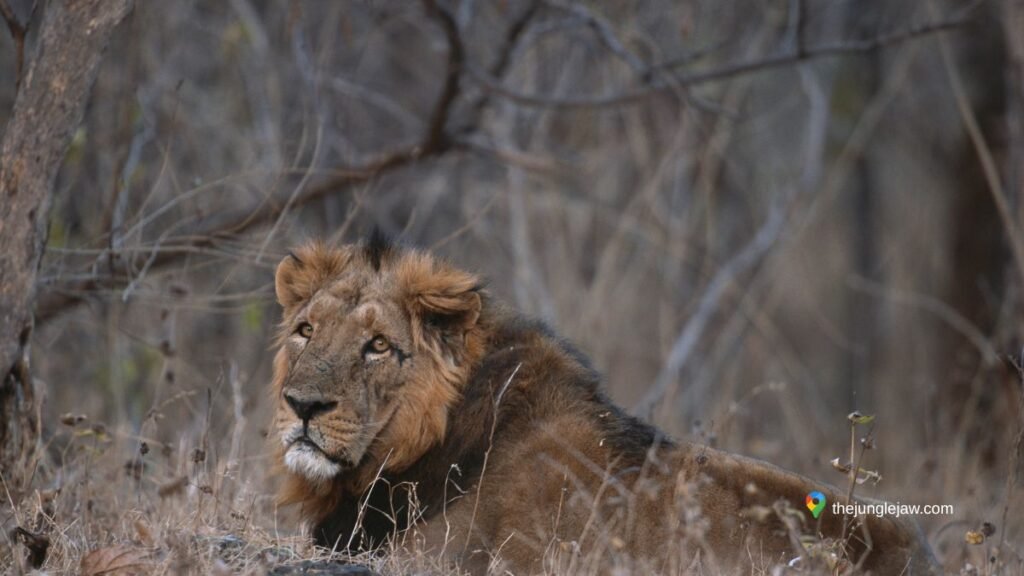
The Asiatic lion is the only wild lion left outside Africa, and every one of them — all 891 recorded in the last census — lives in a single pocket of Gujarat, India. Most are still found in and around Gir National Park, though for the first time in decades, over half now roam beyond it.
Quick Facts: Asiatic Lion
- Scientific name: Panthera leo persica
- Population (2025 census): 891 — up from 674 in 2020
- Where found: Gir National Park & Sanctuary, plus Mitiyala, Pania, Girnar, and Barda sanctuaries, Gujarat
- IUCN status: Endangered (upgraded from Critically Endangered in 2008)
- Historic low: As few as a dozen individuals in the early 1900s
- Distinguishing trait: A longitudinal fold of skin along the belly, absent in most African lions
I still remember the first Gir pride I ever tracked
It wasn’t the roar that got me — it was the silence before it. Gir’s dry teak forest goes quiet in a way open savanna never does, and when a pride of Asiatic lions moves through that stillness, you feel it before you see it. I’ve walked these forest tracks for two decades now, and the Asiatic lion is still the animal that humbles me the most, because its entire existence is a rounding error away from having ended completely.
How close did Asiatic lions come to extinction?
By the early 1900s, hunting and habitat loss had reduced the population to somewhere around a dozen individuals, confined to the Gir forest under the protection of the Nawab of Junagadh. Every Asiatic lion alive today descends from that handful of survivors — which is part of why conservationists still worry about genetic bottlenecking in the population, even as raw numbers climb.
The species is currently classified as Endangered on the IUCN Red List, having been upgraded from Critically Endangered in 2008. That upgrade wasn’t cosmetic — it reflected real, sustained recovery.
Asiatic Lion Population: The 2025 Numbers
The 16th Asiatic Lion Census, conducted in May 2025, recorded 891 lions across Gujarat — a 32.2% increase from the 674 counted in 2020. Break that down and it tells an interesting story: 196 adult males, 330 adult females, 140 sub-adults, and 225 cubs.
What’s changed most isn’t just the total — it’s where the lions are living. Only 384 lions now live inside the core protected areas of Gir National Park and its adjoining sanctuaries, while 507 have been found outside traditional protected habitat entirely. Gir was home to just 523 lions across roughly 22,000 sq km as recently as 2015, so the spread beyond the park’s boundaries is a genuinely new phenomenon — lions have now turned up in coastal habitat near Porbandar, in agricultural belts, even close to villages.
That expansion is being watched carefully. Officials reported that 669 lions died between 2020 and 2025 from causes including old age, illness, injuries, cub mortality, and human-pressure-related accidents like falling into open wells or electrocution — a reminder that population growth and population safety aren’t the same thing, especially as more lions move into human-dominated landscapes.
Why does it matter that lions are leaving Gir?
For decades, “Asiatic lion” and “Gir Forest” were functionally the same story — one population, one place, one flood or one disease outbreak away from disaster. Lions establishing satellite populations in places like Barda Wildlife Sanctuary, where they were recorded for the first time since 1879, is exactly the kind of range expansion conservationists have wanted for years. It spreads the risk. It also raises the odds of a lion wandering into a farmer’s field near Amreli, which is now the single district with the highest lion count in the state.
What Makes an Asiatic Lion Different From an African Lion
I get asked this on almost every safari I run, usually by someone who’s only ever seen lions on a nature documentary shot in the Serengeti. A few real differences, not just trivia:
- The belly fold: Asiatic lions carry a distinct longitudinal skin fold running along the abdomen — the single most reliable field marker, and one African lions typically lack.
- Mane: Males tend toward a sparser mane that leaves the ears visible, unlike the fuller mane associated with African lions.
- Social structure: Asiatic lion prides are typically smaller and looser, and adult males associate with the pride less consistently than in African populations — you’ll often find males in pairs or alone, joining females mainly to mate or feed.
- Habitat: Gir is dry deciduous forest and scrub, a world away from open savanna, and it shapes how these lions hunt and move.
Threats Facing the Asiatic Lion Today
The lion isn’t out of danger just because the count is climbing. Three things worry people who actually work this landscape:
- Genetic bottleneck. Every Asiatic lion descends from a tiny founding population, which limits genetic diversity and raises disease vulnerability.
- Single-region concentration. Despite the recent spread, there is still no second wild population anywhere else on Earth. One large-scale disease event or environmental disaster in Gujarat could still be catastrophic.
- Human-wildlife conflict. As lions increasingly use farmland, open wells, and unfenced settlements at the forest edge, conflict-related deaths have become a bigger factor in lion mortality than they were a generation ago.
The 2018 Outbreak That Nearly Sent Gir Lions Backward
Between September 12 and October 2, 2018, 23 lions died in the Gir Wildlife Sanctuary and National Park in the span of roughly three weeks. The cause was eventually traced to a combined outbreak of Canine Distemper Virus (CDV), spread from domestic dogs in villages around the park, and Babesiosis, a tick-borne parasite that destroys red blood cells. Laboratory investigation later confirmed the virus strain in samples from dozens of lions and several leopards.
It was a genuine scare, not a routine die-off. CDV had already wiped out roughly a third of the Serengeti’s lion population in Tanzania in 1994, and Gir’s lions — genetically near-identical to one another thanks to that shared founding population — had almost no natural resistance to fall back on. Wildlife veterinarians and the Indian Council of Medical Research pushed for an emergency response: the Gujarat Forest Department imported CDV vaccine doses from the United States and ran a vaccination drive across cattle and dogs in 20 villages bordering the park, targeting the disease at its most likely source rather than the lions directly.
The outbreak reignited a debate that had already been simmering for years — whether keeping the entire wild population in one contiguous landscape is simply too risky long-term, no matter how well protected that landscape is.
A fresh reminder in 2026: In late May 2026, forest officials again isolated 17 lions after a cluster of deaths — four cubs and three adults over ten days — suspected to involve Babesia and possibly CDV once more. It’s a live example of exactly the vulnerability conservationists have been warning about since 2018: a genetically narrow population concentrated in one place will keep facing this risk until there’s a genuine second stronghold somewhere else.
Should Some Lions Move to Kuno? The Decade-Long Debate
In 2013, the Supreme Court of India ordered the government to translocate a portion of the Gir lion population to Kuno National Park in Madhya Pradesh, specifically to establish a second wild population as insurance against exactly the kind of outbreak described above. More than a decade later, not a single lion has been moved.
The reasons are as much political as ecological. Gujarat has consistently resisted parting with lions that have become a symbol of state identity, and has cited disease-risk and habitat-readiness concerns to delay compliance. Meanwhile Kuno itself changed direction: it became the release site for India’s African cheetah reintroduction program instead, starting in 2022, which the central government has cited as a reason to hold off on introducing a second large predator into the same landscape while the cheetah population is still establishing itself.
The Centre told the Supreme Court it would re-examine the translocation question given the cheetah program’s progress, with a status report promised — but as of 2026, Kuno hosts cheetahs, not lions, and the core problem the 2013 order was meant to solve (a single, geographically concentrated population) still exists. Whether that changes is genuinely an open question, and one worth revisiting as Project Lion’s implementation continues.
Frequently Asked Questions
Are Asiatic lions the same species as African lions?
Yes — both are Panthera leo, but Asiatic lions are a distinct subspecies, Panthera leo persica, with visible physical and behavioral differences from their African counterparts.
How many Asiatic lions are left in the wild?
891, according to the 16th Asiatic Lion Census conducted by the Gujarat Forest Department in May 2025.
Where can you see Asiatic lions in the wild?
Almost entirely in Gujarat, India — primarily Gir National Park and Sanctuary, with smaller populations now established in Girnar, Mitiyala, Pania, and Barda sanctuaries.
Why are Asiatic lions only found in Gujarat?
Historical hunting and habitat loss wiped out lion populations across the rest of their former range, which once stretched from the Mediterranean through the Middle East into India. Gir was the last forest where a population survived.
Are Asiatic lion numbers actually increasing?
Yes — the population has grown from around 327 in 2001 to 891 in 2025, though conservationists remain cautious given genetic bottlenecking and rising human-wildlife conflict as lions expand into non-forest areas
