
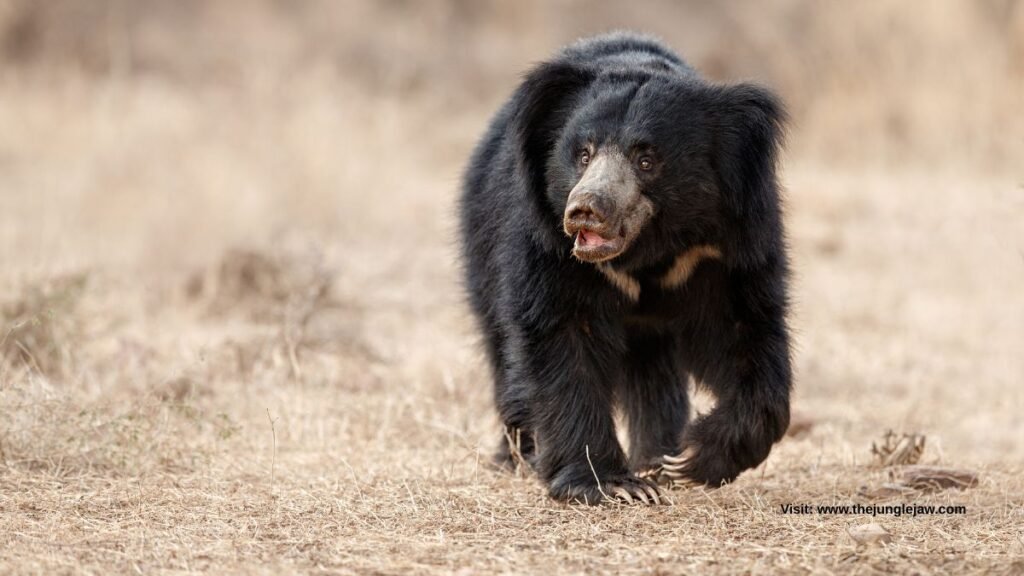
Ask most people to name a dangerous Indian animal and they’ll say tiger. Ask a forest guard, and there’s a real chance they’ll say sloth bear. It’s not the biggest predator in the jungle and it’s not even fully carnivorous — but pound for pound, an Indian sloth bear surprised at close range is one of the least predictable animals you can meet on a forest trail.
Quick Facts: Sloth Bear
- Scientific name: Melursus ursinus
- Global population: Roughly 10,000–20,000, and declining
- IUCN status: Vulnerable, with an estimated 30–49% decline over the last three generations
- Range: India, Sri Lanka, and Nepal; historically Bangladesh and Bhutan
- Diet: Mostly termites and ants, plus fruit, flowers, and honey
- Unique trait: The only bear species that routinely carries its cubs on its back as a primary way of getting around
Table of Contents
Why Is It Called a “Sloth” Bear If It’s Not a Sloth?
The name is a 200-year-old mistake. When naturalist George Shaw first described the species in 1791, he mistook its long claws and shuffling gait for a relative of the true sloth and named it Bradypus ursinus — “bearlike slow-foot.” The confusion was corrected once more specimens were studied, but the misleading name stuck. In reality, sloth bears are anything but slow: they’re active foragers, capable tree climbers, and can move fast enough to close distance on a startled human in seconds.
Indian Elephant Behaviour in India: Discover the Remarkable Life of India’s Gentle Giant
How Sloth Bears Actually Eat: The Vacuum-Mouth Trick
This is the detail that makes sloth bears genuinely unique among bears, not just Indian wildlife. They lack a full set of upper incisors, and their lower lip and palate are unusually mobile and elongated. Faced with a termite mound, a sloth bear tears it open with three-inch curved claws, closes its nostrils to keep insects out, then presses its lips into a tube shape and sucks the insects out — a process loud enough to be heard over 100 meters away in a quiet forest. It’s an oddly specific evolutionary solution, and it’s the reason old field guides sometimes call them “labiated bears.”
Sloth Bear Population: How Many Are Left?
Reliable large-scale counts are genuinely hard to come by for this species — unlike tigers, sloth bears aren’t subject to a nationwide synchronized census. The working estimate from the IUCN and Bear Specialist Group puts the global population somewhere between 10,000 and 20,000 individuals, with India’s potential habitat spanning roughly 400,000 square kilometers across 19 states.
What’s clearer is the trend: populations have declined an estimated 30–49% over the last three generations, driven by habitat fragmentation, retaliatory killing after crop-raiding or human encounters, and poaching for bile and claws used in traditional medicine.
One number worth sitting with: researchers estimate that one-half to two-thirds of India’s sloth bears live outside formally protected areas — meaning most of this “Vulnerable” species’ fate depends on how well unprotected forest fragments and human-adjacent habitat are managed, not just what happens inside national parks.
Why Sloth Bears Can Be More Dangerous Than Tigers Up Close
This sounds like a bold claim until you understand the mechanism. Tigers are ambush predators that generally avoid humans and rarely attack without a specific trigger. Sloth bears are different: they’re near-sighted, easily startled, and their instinctive response to a sudden close encounter — especially a mother with cubs — is to charge and use those long claws defensively, rather than flee.
Forest department records across central India consistently show sloth bear encounters causing more human injuries per incident than tiger encounters in the same landscapes, simply because bears are more likely to react to surprise with aggression rather than avoidance. They’re also documented fighting off tigers and leopards in defense of themselves or their cubs — one of the few Indian animals that will actually stand its ground against a big cat.
The Dancing Bears of India: A Dark Chapter, Mostly Closed
For centuries, young sloth bear cubs were captured from the wild by the nomadic Kalandar community and trained — through methods now recognized as severely cruel — to perform as “dancing bears” for tourists and villagers. The practice was formally banned in India, and by 2009, the NGO Wildlife SOS had rescued and rehabilitated the last known dancing bears in the country, working directly with Kalandar families to transition them into alternative livelihoods. It’s one of the genuine conservation success stories connected to this species — though poaching for body parts remains an active threat today, just a different one.
Where to See Sloth Bears in the Wild
Sloth bears are harder to reliably spot than tigers or elephants — they’re mostly nocturnal or crepuscular where humans are present, and naturally wary. A few places stand out:
- Daroji Sloth Bear Sanctuary, Karnataka — the only sanctuary in India established specifically for sloth bears, near Hampi, with a dedicated viewing area and unusually reliable sightings.
- Satpura Tiger Reserve, Madhya Pradesh — widely considered one of the best parks in India for sloth bear sightings in a natural, undisturbed setting, partly because it’s quieter and less crowded than Kanha or Bandhavgarh.
- Ranthambore and Nagzira — both have healthy sloth bear populations, though sightings there take a back seat to tiger safaris in most itineraries.
Frequently Asked Questions
Are sloth bears dangerous to humans?
Yes, disproportionately so for their size. They’re not aggressive hunters of humans, but sudden close encounters — especially with a mother and cubs — often trigger a defensive charge rather than flight, making surprise encounters riskier than their modest size suggests.
What do sloth bears eat?
Primarily termites and ants, extracted using a specialized vacuum-like sucking method, supplemented with fruit, flowers, and honey — hence their old nickname “honey bear.”
How many sloth bears are left in the world?
An estimated 10,000 to 20,000, with populations continuing to decline due to habitat loss, human conflict, and poaching.
Why do sloth bear cubs ride on their mother’s back?
It’s a trait unique to this species among all bears — cubs cling to the extra-long fur on their mother’s back as their primary mode of transport until they’re around 6–9 months old, likely as protection from ground-level threats like tigers.
Is the sloth bear the inspiration for Baloo in The Jungle Book?
Most wildlife writers believe so — Baloo’s shaggy build and Indian setting align far more closely with the sloth bear than with any Asiatic black bear, even though illustrations have often depicted him differently.