
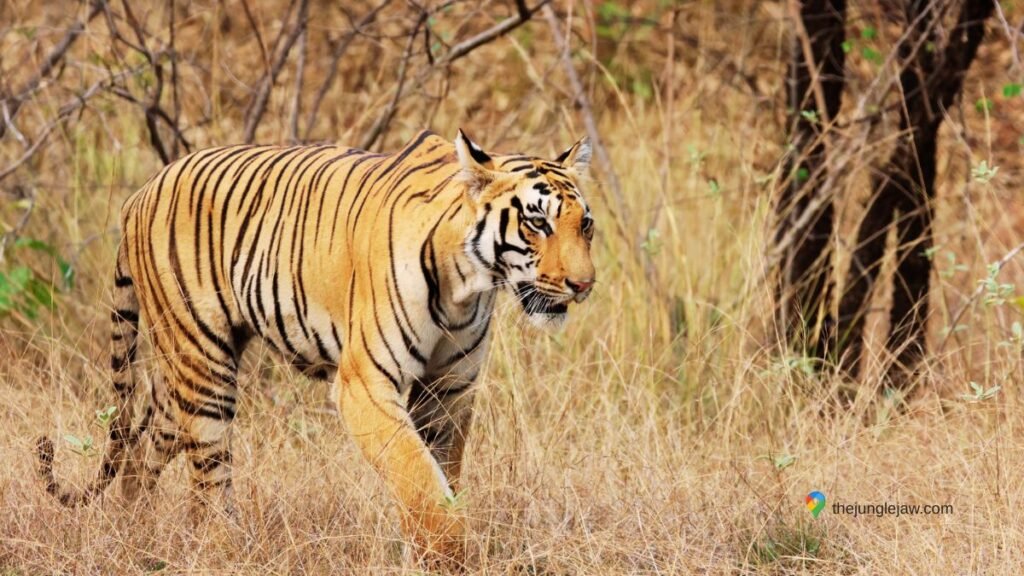
If you type “Bengal Tiger in India” into Google right now, you’ll get a hundred articles telling you it’s the national animal, it’s orange with black stripes, and it’s endangered. Thanks. We knew that in third grade.
I’ve spent years chasing pug marks through the dust of Ranthambore, sitting silently in a jeep at 6 AM in Bandhavgarh, and talking to forest guards who’ve spent their whole lives protecting these cats. So let’s skip the textbook stuff. Let’s talk about the Bengal Tiger in India the way nobody else will — the weird, brutal, beautiful truth of it.
Ready? Grab your chai. This is going to be a long, honest one.
Why the Bengal Tiger in India Is Not Just “A Big Cat”
Here’s a question for you: how does an animal weighing as much as three grown men manage to disappear in grass barely up to your knee?
That’s the first thing that breaks your brain when you see a Bengal Tiger in India in the wild. You expect a monster. What you get is a ghost. It doesn’t crash through the forest like an elephant. It flows. One second there’s nothing, the next second there’s 200 kilograms of muscle staring straight through your soul, ten feet away, and you never even heard it move.
That’s not luck. That’s engineering.
The Stripe Pattern Is a Fingerprint, Not a Uniform
No two Bengal tigers in India have the same stripe pattern. Ever. It’s like a barcode stamped onto fur, and forest departments actually use it to identify individual tigers in camera trap photos — no two “T-numbers” (the ID codes given to tigers in reserves like Ranthambore) look alike. Some conservationists can recognise a specific tiger from a single blurry photo, the way you’d recognise a friend’s handwriting.
Tigers Don’t Roar for Fun — It’s a 3km Broadcast
A tiger’s roar isn’t a “hello.” It’s a real estate announcement. A full-grown Bengal Tiger in India can roar loud enough to be heard almost 3 kilometres away on a still night. Females use it to call for mates, males use it to warn rivals off their turf, and honestly, if you’ve ever heard one for real at a tiger reserve, you don’t forget the way it seems to vibrate in your chest.
Where the Bengal Tiger in India Actually Lives (And Why Some Reserves Fail)
People assume tigers just live “in the jungle.” But not all jungles are equal, and this is where it gets interesting.
The Big Four Reserves Everyone Talks About
- Ranthambore National Park, Rajasthan — dry deciduous forest, dramatic ruins, and some of the most photographed tigers on Earth.
- Bandhavgarh National Park, Madhya Pradesh — the highest tiger density in India. If you want odds, this is where you go.
- Kanha National Park, Madhya Pradesh — the forest that inspired Rudyard Kipling’s Jungle Book.
- Sundarbans National Park, West Bengal — the only mangrove tiger population on the planet, where tigers are known to swim between islands and, unlike anywhere else, have occasionally hunted humans.
Why Sundarbans Tigers Are Genuinely Different
Ask any forest official and they’ll tell you Sundarbans tigers are a different breed of dangerous. Fresh water is scarce, prey is limited, and the tigers there have adapted to swim across tidal creeks and hunt in salt marsh conditions no other tiger population deals with. It’s the one place in India where the tiger is not just a symbol of the forest — it’s a genuine, active part of daily human life and danger for the fishing communities nearby.
How the Bengal Tiger in India Actually Hunts
This is the part that surprises people most. We picture tigers sprinting like cheetahs. Wrong movie.
A tiger’s hunting style is closer to a poker player than a sprinter. It’s patient. Painfully patient. A Bengal tiger in India might stalk a herd of spotted deer (chital) for over an hour, moving inches at a time, using every blade of grass and shadow as cover.
Think of it like this: a cheetah is a sprinter racing for a medal. A tiger is a chess player waiting for the one move that guarantees checkmate. It gets one real shot, maybe two, and it needs it to count — because a failed ambush burns energy the tiger may not get to replace for days.
The 10% Rule That Explains Everything
Here’s a wild stat: most hunts by a Bengal Tiger in India fail. Somewhere around 90% of ambush attempts don’t end in a kill. That’s why they don’t waste energy chasing. Why sprint after something with 10% odds of success when you could wait five more minutes for 80% odds instead?
The Tiger Numbers Story: From Almost Gone to Genuinely Recovering
This is honestly the part of the Bengal Tiger in India story that deserves more attention than it gets.
In 1900, there were believed to be over 40,000 tigers roaming the Indian subcontinent. By 2006, that number had crashed to just 1,411 in the wild — a number so low that scientists genuinely worried the Bengal tiger in India could disappear within a generation.
Then something rare happened in conservation: it actually started working.
Through Project Tiger (launched way back in 1973) and continued protection efforts, India’s tiger population has been recovering steadily. As of the last official tiger census, India is home to roughly 70-75% of the entire world’s wild tiger population. Read that again. Three out of every four wild tigers left on Earth are walking around Indian forests right now.
If you want to see the official government numbers and methodology yourself, the National Tiger Conservation Authority publishes them directly — check the NTCA’s official tiger status reports here — and the WWF’s tiger conservation page breaks down the global picture in plain English too.
Why This Recovery Actually Matters to You (Yes, You, Reading This in the US or UK)
You might be thinking, “cool story, but why should I care from London or Chicago?” Fair question.
Tigers are what conservationists call an “umbrella species.” Protect the tiger’s habitat, and you’re automatically protecting hundreds of other species living in that same forest — deer, langurs, birds, even the water systems that millions of people downstream depend on. Save the tiger, and you save the whole forest underneath it. It’s not charity. It’s a chain reaction.
What Threatens the Bengal Tiger in India Today
The threats haven’t disappeared — they’ve just changed shape.
- Habitat fragmentation — highways and railway lines slicing through tiger corridors, cutting one population off from another.
- Human-wildlife conflict — as tiger numbers recover, tigers are running out of protected space, leading to more run-ins near villages.
- Poaching for the illegal wildlife trade — still active, still deadly, still driven by demand for tiger parts abroad.
- Prey depletion — a tiger can’t survive in a forest with no deer or wild boar left to hunt, even if the forest itself looks untouched.
You can check the current official conservation status directly on the IUCN Red List page for tigers — it’s regularly updated and gives you the real scientific classification, not a guess.
A Day in the Life of a Bengal Tiger in India
Let’s make this personal for a second. Picture a female tiger in Bandhavgarh. She wakes near a waterhole close to sunset — tigers are mostly crepuscular, meaning they’re most active at dawn and dusk, not high noon like the documentaries make you believe. She patrols her territory, marking trees with scent (yes, tigers “spray” trees the way your neighbourhood dog marks lamp posts, just with a lot more menace behind it). She might travel 10-15 kilometres in a single night. If she has cubs, she hides them in dense grass while she hunts alone, because a hungry mother is the only provider those cubs have.
That’s the real life of a Bengal Tiger in India. Not a Discovery Channel highlight reel. A daily grind of territory, hunger, and survival.
Fascinating Bengal Tiger Facts People Rarely Talk About
- A tiger’s night vision is roughly six times better than a human’s.
- Each tiger’s territory can range from 20 sq km (in prey-rich areas like Bandhavgarh) to over 100 sq km in poorer habitats.
- Tigers are excellent swimmers — unlike most cats, they actually enjoy water and will cool off in ponds during India’s brutal summers.
- A tiger’s canine teeth can be up to 7.5 cm long — built to sever the spinal cord of prey in a single, precise bite.
Why the Bengal Tiger in India Deserves Your Attention Right Now
So here’s my honest question to you: when was the last time you thought about an animal that isn’t sitting in your living room?
The Bengal Tiger in India isn’t a mascot. It’s not a logo on a cereal box. It’s a living, breathing warning system for how healthy — or broken — an entire ecosystem is. Where the tiger thrives, the forest thrives. Where the tiger vanishes, everything underneath it usually follows quietly, without headlines.
If you ever get the chance to visit India — Ranthambore, Bandhavgarh, Kanha, or Sundarbans — go. Sit in that jeep at 6 AM in the cold. Wait. Because the day you lock eyes with a wild Bengal tiger in India for the first time, something shifts. You stop reading about conservation and you start caring about it.
Want to go deeper? Check out our full breakdown of India’s Apex Predators in the Wild Wiki, or explore our detailed guides on Ranthambore National Park and Bandhavgarh National Park if you’re planning your first safari. And for the bigger conservation picture, our Project Tiger updates in Conservation Lab go into exactly how India brought this cat back from the edge.
A Quick Note on Sources
This article draws on publicly available data from the National Tiger Conservation Authority, WWF India, and IUCN Red List assessments, alongside firsthand observations from Indian tiger reserves.