
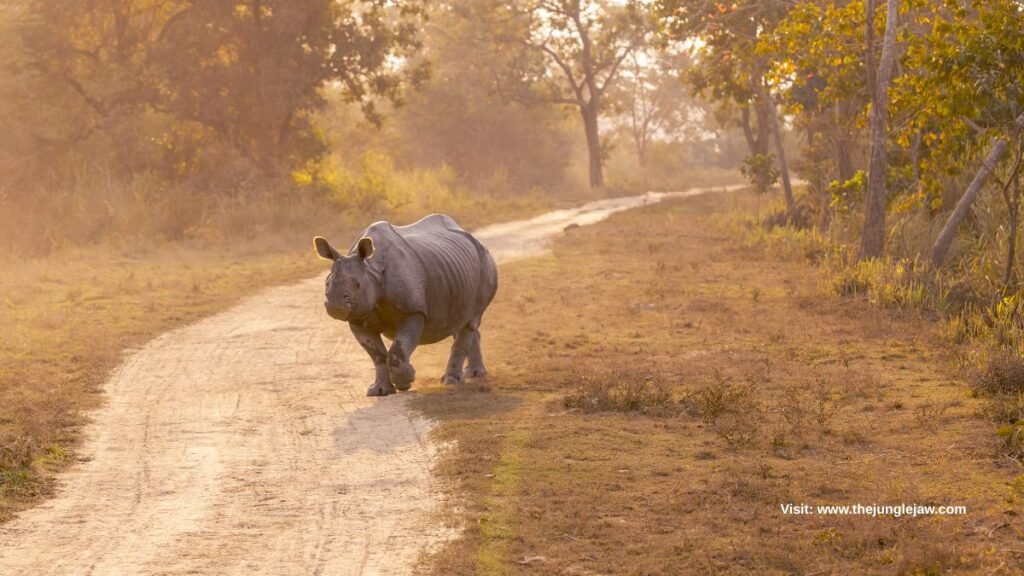
Walk along the grasslands of Kaziranga at dawn and you’ll eventually see one standing motionless in the mist — a grey-brown shape with skin folded so deeply it genuinely looks armor-plated, built like something that should have gone extinct alongside the dinosaurs. In a sense, it nearly did go extinct. What’s happened since is one of the most underrated conservation turnarounds in Asia.
Quick Facts: Greater One-Horned Rhino
- Scientific name: Rhinoceros unicornis
- Also known as: Indian rhino
- Global population (2024–25): Approximately 4,075 — India ~3,323, Nepal ~752
- IUCN status: Vulnerable (downlisted from Endangered in 2008)
- Historic low: Fewer than 200 individuals in the early 20th century
- Where found: Overwhelmingly concentrated in Kaziranga National Park, Assam, with smaller populations in West Bengal, Uttar Pradesh, and Nepal’s Chitwan
Table of Contents
The Rhino That Came Back From the Brink
Hunting and habitat clearance pushed the greater one-horned rhino down to fewer than 200 individuals by the early 1900s. When Kaziranga was first declared a protected area in 1908, it held just 12 rhinos. What followed over the next century is the actual headline: sustained protection turned that number into a population approaching 3,000 in India alone, and in 2008 the IUCN downlisted the species from Endangered to Vulnerable — the only large mammal in Asia to ever receive that downgrade. That’s not a small technical detail; it’s a formal acknowledgment that a species genuinely pulled back from the edge.
Sloth Bear India Facts: The Jungle’s Most Misunderstood Predator
How Many One-Horned Rhinos Are Left Today?
The most recent comprehensive figures put the global population at roughly 4,075, split between India (around 3,323) and Nepal (around 752), according to the International Rhino Foundation’s State of the Rhino report. But “global population” is a slightly misleading phrase here — this species is really a story of one park. Kaziranga National Park and Tiger Reserve alone holds around 2,613 rhinos, which is somewhere in the range of 70% of the entire global population, concentrated in a single landscape in Assam.
The rest are scattered thinly: Jaldapara and Gorumara in West Bengal now hold a combined 392 as of 2025, Pobitora Wildlife Sanctuary in Assam has the highest rhino density on Earth (over 100 rhinos packed into just 16 square kilometers), and Dudhwa National Park in Uttar Pradesh holds a small population representing about 1% of India’s total.
Why Putting Most of a Species in One Park Is a Problem, Not Just a Success
This should sound familiar — it’s structurally the same risk facing the Asiatic lion in Gir. When 70% of a species’ global population lives in one place, a single catastrophic flood, disease outbreak, or security lapse threatens a huge share of the species at once. Kaziranga floods almost every monsoon season, and rhinos have drowned or been swept into human settlements during severe flood years. It’s precisely why the Wildlife Institute of India’s 2023 rhino action plan proposed actively translocating rhinos out of Kaziranga and Pobitora — both assessed as being at or near their sustainable population density — to build up genuinely independent populations elsewhere, rather than just letting numbers keep growing in the same few pockets.
What Makes This Rhino “The True Unicorn”?
Unlike African rhino species, which typically carry two horns, the greater one-horned rhino has just one — a single black horn that gives it the nickname “the true unicorn of the rhino world.” Combine that with skin that folds into thick plates around the shoulders, neck, and legs, and you get an animal that looks less like a modern mammal and more like a walking fossil. It’s also the largest of all rhino species, and despite that scale, its diet is almost entirely grass — it’s a grazer first, only occasionally browsing on leaves, fruit, and aquatic plants.
Threats: Poaching Isn’t the Main Story Anymore
For decades, poaching for rhino horn — driven by demand in traditional medicine markets, despite horn being made of keratin with no proven medicinal value — was the dominant threat. That’s shifted. Assam recorded zero poaching incidents in 2022, a genuine enforcement success driven by dedicated anti-poaching forces and tougher prosecution under the Wildlife Protection Act’s Schedule I protections. The bigger risks now are structural: habitat compression, flood vulnerability, and the genetic and disease risks that come from most of the world’s rhinos living in a handful of protected pockets rather than a wide, connected range.
Frequently Asked Questions
How many one-horned rhinos are left in the world?
Approximately 4,075 as of the most recent comprehensive count, with around 3,323 in India and 752 in Nepal.
Why are most one-horned rhinos in Kaziranga?
Sustained, well-funded protection over more than a century turned Kaziranga into the species’ safest stronghold, and rhinos naturally concentrated there as poaching and habitat loss eliminated populations elsewhere across their historic range.
Are one-horned rhinos still endangered?
They’re currently classified as Vulnerable, having been downlisted from Endangered in 2008 — a genuine recovery, though the species remains at risk due to its concentration in just a few locations.
How is a one-horned rhino different from an African rhino?
It has a single horn rather than two, and its skin forms deep folds that give it an armor-plated appearance — a look no African rhino species shares.
Is Kaziranga overcrowded with rhinos now?
Wildlife authorities have assessed parts of Kaziranga and Pobitora as approaching their sustainable rhino density, which is part of why translocation to new sites is now being planned rather than simply allowing numbers to keep growing in the same protected areas