
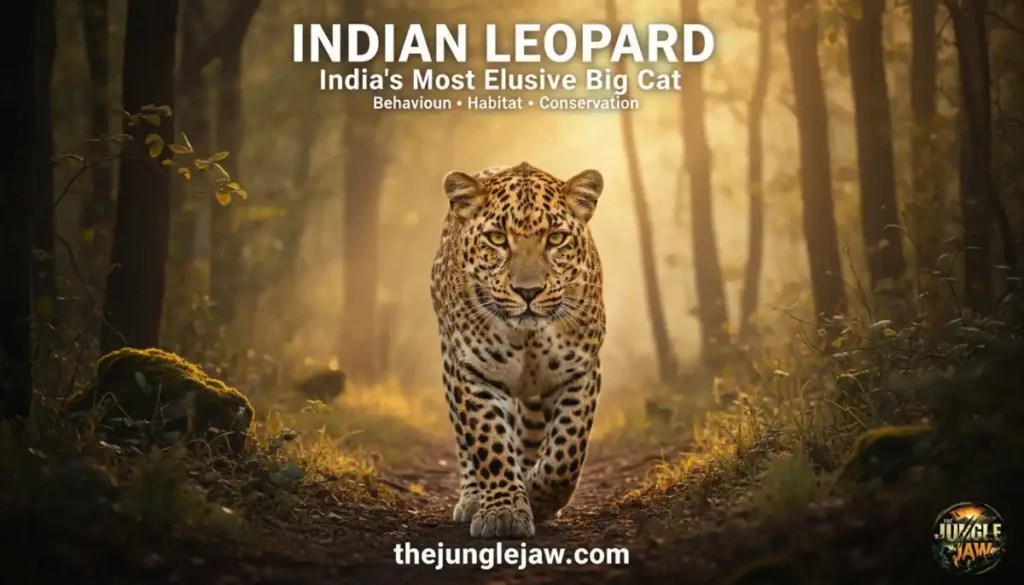
Indian Leopard in India: The Phantom Predator Thriving Among People
A Ghost in the Darkness
The alarm call comes first.
A chital stag barks sharply from the edge of a dry riverbed. Langurs scramble higher into the canopy. The forest seems to hold its breath. Yet unlike a tiger, whose presence often announces itself through dominance and power, the predator responsible remains invisible.
Then, for a brief second, a pair of golden eyes catches the fading light.
An Indian Leopard slips silently between the shadows and disappears once again.
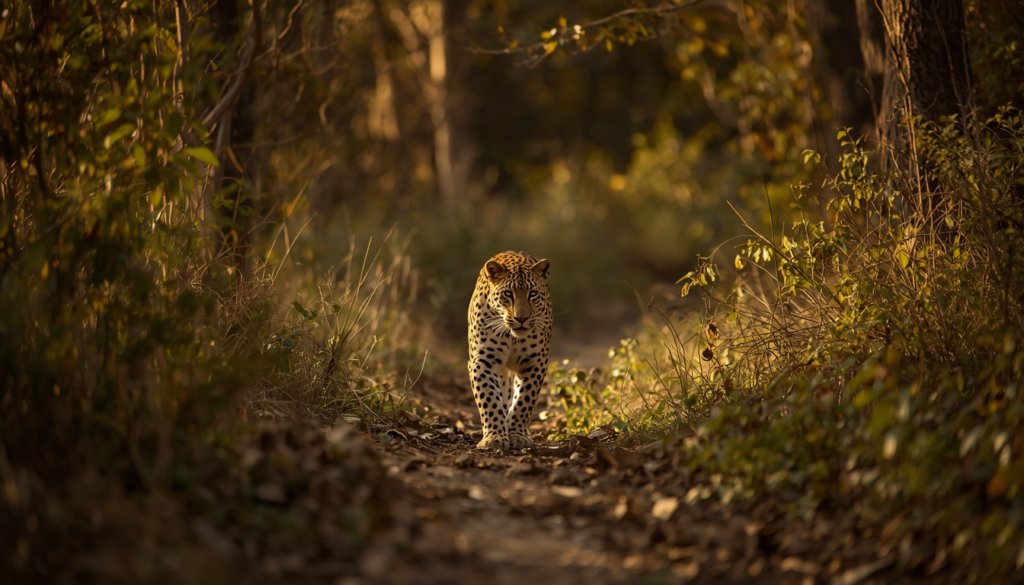
Few animals embody mystery quite like the Indian Leopard. It lives in some of the most densely populated regions on Earth, shares landscapes with millions of people, and survives in habitats ranging from Himalayan forests to semi-arid scrublands. Yet despite its widespread presence, most people will never see one in the wild.
For wildlife lovers, the Indian Leopard represents one of nature’s greatest success stories—and one of its most misunderstood predators.
Table of Contents
Why the Indian Leopard Matters
The Indian Leopard is arguably the most adaptable large carnivore in Asia.
While tigers require extensive protected forests and lions survive within a limited range, leopards have mastered survival in an astonishing variety of environments. They occupy dense forests, rocky hills, agricultural landscapes, tea estates, grasslands and even areas close to major cities.
This adaptability makes the species ecologically important. Leopards help regulate prey populations, maintain ecosystem balance and often function as apex predators in areas where tigers are absent.
Yet their ability to live near humans has created unique conservation challenges. Every leopard sighting near a village sparks curiosity, concern and sometimes conflict.
Understanding this remarkable cat is essential if India’s wildlife and human communities are to coexist successfully.
Key Facts: Indian Leopard
| Fact | Details |
|---|---|
| Common Name | Indian Leopard |
| Scientific Name | Panthera pardus fusca |
| IUCN Status | Vulnerable |
| Average Weight | Males: 50–77 kg; Females: 29–45 kg |
| Length | Up to 2.4 metres including tail |
| Lifespan | 12–17 years in the wild |
| Diet | Deer, wild boar, monkeys, dogs, livestock and smaller mammals |
| Range | Across most of India, Nepal, Bhutan and parts of Pakistan |
| Activity Pattern | Primarily nocturnal and crepuscular |
| Conservation Status in India | Protected under Schedule I of the Wildlife Protection Act |
Built for Survival: The Biology of India’s Most Adaptable Big Cat
The Indian Leopard belongs to one of the most successful predator lineages on Earth.
Unlike the heavily built tiger or the social lion, the leopard combines strength, agility and intelligence in a compact package.
Adult males typically weigh between 50 and 77 kilograms, though individuals can be larger in prey-rich habitats. Their muscular bodies, powerful jaws and extraordinary climbing ability allow them to exploit opportunities unavailable to most predators.
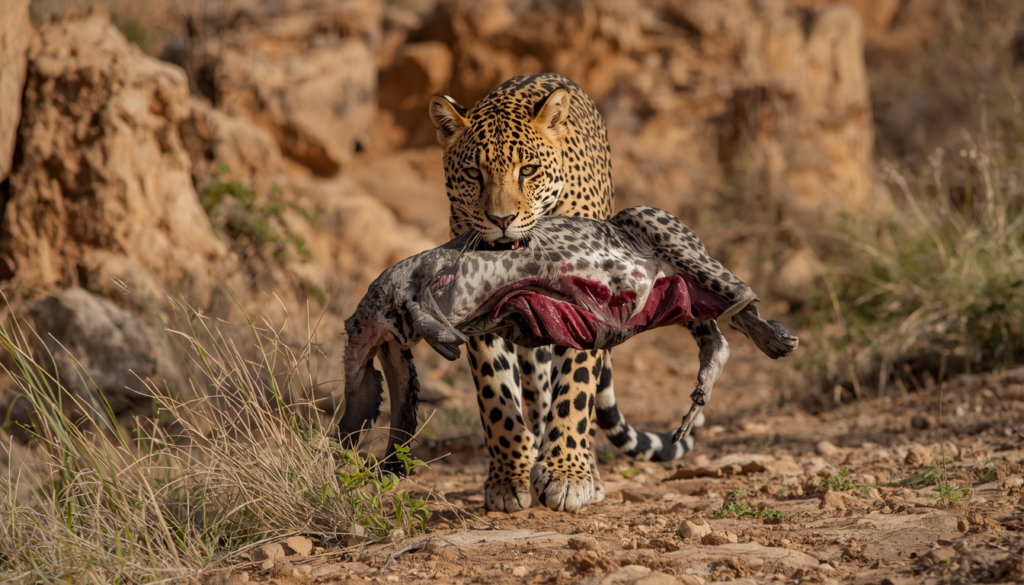
The leopard’s iconic coat is covered in rosette-shaped markings. These aren’t merely beautiful; they are evolutionary masterpieces. In dappled forest light, rocky terrain and dry grasslands, the pattern breaks up the animal’s outline, making it almost invisible.
Research has shown that leopards possess remarkable spatial memory. Individuals can remember hunting routes, den sites, water sources and territorial boundaries across vast landscapes.
Perhaps most impressive is their climbing ability.
Leopards routinely haul prey heavier than themselves into trees to protect it from scavengers. Watching a leopard drag a freshly killed chital up a near-vertical trunk is one of wildlife’s most extraordinary displays of strength.
Indian Leopard Behaviour: Masters of Stealth and Adaptation
If tigers rule through dominance, leopards survive through intelligence.
Indian Leopards are largely solitary, meeting only for mating or when females are raising cubs. They communicate through scent marking, scratch marks and vocalisations ranging from growls to a distinctive rasping call often compared to the sound of sawing wood.
Their hunting strategy reflects patience and efficiency.
Unlike cheetahs that depend on speed or lions that hunt cooperatively, leopards rely on stealth. They approach prey with painstaking care, using every bush, rock and shadow as cover.
A successful hunt often ends with a sudden explosive charge over a short distance.
Surprisingly, leopards are opportunistic feeders. Their diet includes everything from insects and rodents to large deer and wild boar.
This flexibility explains much of their success.
Where prey is scarce, leopards adapt. Where forests shrink, they adjust. Few predators demonstrate such behavioural resilience.
Recent studies have even documented leopards navigating roads, railway corridors and agricultural landscapes with remarkable sophistication, often moving through human-dominated areas unnoticed.
Indian Leopard Habitat: From Himalayan Forests to Sugarcane Fields
The Indian Leopard occupies one of the broadest habitat ranges of any large predator in Asia.
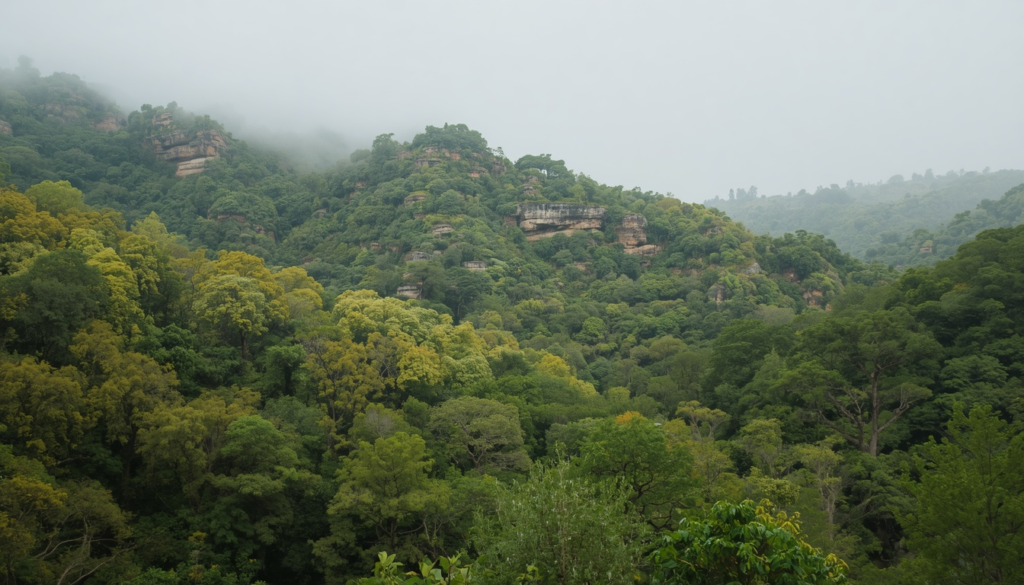
Their distribution spans nearly the entire Indian subcontinent.
Tropical Forests
Central India’s teak and sal forests support some of the country’s healthiest leopard populations. Here they coexist alongside tigers while occupying slightly different ecological niches.
Dry Deciduous Landscapes
Leopards thrive in the rocky hills and scrub forests of Rajasthan, Gujarat and parts of Maharashtra.
Himalayan Foothills
The Terai Arc and lower Himalayan forests provide rich habitat with abundant prey.
Western Ghats
Dense evergreen forests in Karnataka, Kerala and Tamil Nadu support significant leopard populations.
Human-Dominated Landscapes
Perhaps the most surprising habitat is agricultural land.
In Maharashtra and parts of Karnataka, leopards have adapted to sugarcane fields, using them as cover and breeding sites. These landscapes highlight both the species’ resilience and the complexity of human-wildlife coexistence.
No other large Indian predator has adapted so effectively to living alongside people.
Surprising Facts About Indian Leopards
Even seasoned wildlife enthusiasts are often surprised by the leopard’s capabilities.
They Are Stronger Than They Look
Relative to body size, leopards are among the strongest big cats on Earth.
They Are Exceptional Climbers
They can descend trees headfirst—an ability few large predators possess.
Melanistic Leopards Exist in India
Popularly called “black panthers,” these leopards possess excess pigmentation. They are particularly associated with parts of the Western Ghats.
They Are More Common Than Tigers
Although sightings are rarer, leopards occupy a much larger geographic range.
They Often Live Undetected
Researchers have documented leopards living close to major towns and cities while remaining largely unseen by local residents.
This ability to remain hidden is a major reason the species has survived where other large predators have disappeared.
Threats Facing the Indian Leopard
Despite their adaptability, Indian Leopards face growing challenges.
Human-Leopard Conflict
As human populations expand, encounters become increasingly common.
Livestock predation and accidental encounters sometimes trigger retaliatory actions against leopards.
Habitat Fragmentation
Roads, railways, mining operations and urban development divide habitats into smaller patches.
Poaching and Illegal Wildlife Trade
Leopard skins, claws, teeth and bones continue to attract illegal trade networks.
Declining Prey Base
Overhunting of wild prey species can force leopards to rely on livestock, increasing conflict risks.
Negative Perceptions
Media sensationalism occasionally portrays leopards as dangerous predators rather than complex wildlife species navigating human-dominated landscapes.
Conservationists increasingly emphasise coexistence strategies rather than conflict-focused approaches.
Conservation Status: Protecting India’s Most Resilient Big Cat
The Indian Leopard is classified as Vulnerable by the IUCN.
In India, the species receives the highest legal protection under the Wildlife Protection Act.
Conservation efforts focus on several key areas:
Protected Areas
National parks and wildlife sanctuaries continue to provide secure habitats.
Landscape-Level Conservation
Researchers increasingly recognise that leopard conservation cannot rely solely on protected areas.
Many leopard populations live outside reserve boundaries, requiring broader planning approaches.
Community Awareness Programmes
Education initiatives help local communities understand leopard behaviour and reduce conflict.
Scientific Monitoring
Camera traps, satellite telemetry and genetic studies provide valuable insights into population trends and movement patterns.
Rapid Response Teams
Several states have developed specialised wildlife teams to address conflict situations safely and effectively.
The future of the Indian Leopard depends not only on protecting forests but also on building coexistence models in shared landscapes.
Where to See the Indian Leopard in India
For wildlife enthusiasts hoping to observe Indian Leopards in the wild, these destinations offer some of the best opportunities.
1. Jhalana Leopard Reserve, Rajasthan
Often considered India’s premier leopard-viewing destination, Jhalana offers exceptional sighting opportunities close to Jaipur.
2. Jawai, Rajasthan
Famous for leopards living among dramatic granite hills and local communities.
3. Kabini, Karnataka
The forests around Kabini support healthy leopard populations, including occasional sightings of melanistic individuals.
4. Bera, Rajasthan
Known for remarkable leopard-human coexistence and excellent photography opportunities.
5. Sanjay Gandhi National Park, Maharashtra
One of the world’s most fascinating urban leopard landscapes, located within the Mumbai metropolitan region.
The Future of the Phantom Predator
The Indian Leopard survives because it has learned what few large predators can: adaptation.
It moves through forests, farms, villages and mountains with extraordinary intelligence. It lives among millions of people while remaining largely unseen. Yet its future remains tied to our choices.
Every forest corridor protected, every conflict prevented and every informed conversation about coexistence contributes to the survival of this remarkable species.
The next time you walk through an Indian forest and hear an alarm call echo through the trees, remember that a leopard may be watching from somewhere nearby.
You may never see it.
But that quiet presence is a reminder that India’s wild heart still beats strong.
Related Reading on The Jungle Jaw
- Wild Wiki: Bengal Tiger
- Wild Wiki: Asiatic Lion