
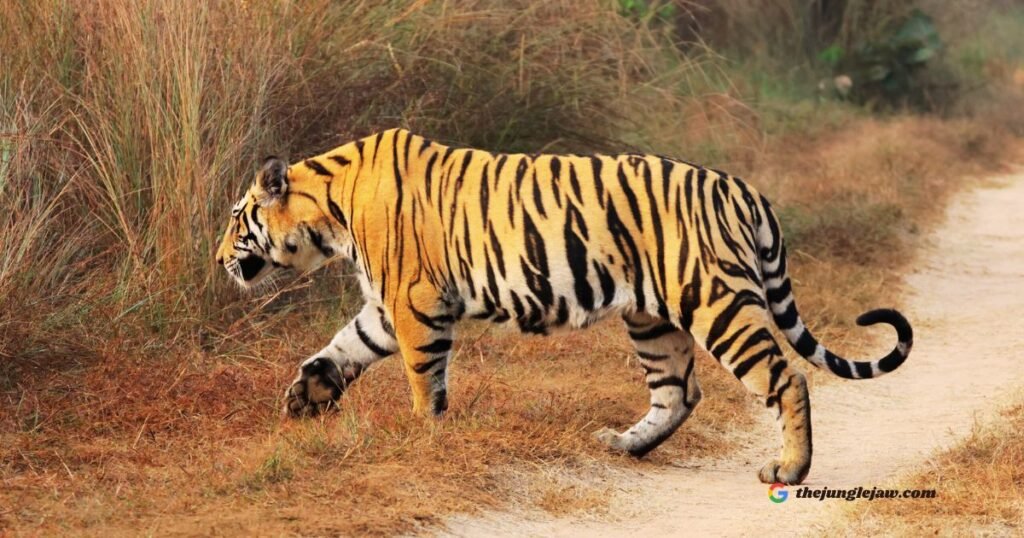
Indian tigers in the wild vs zoos show a clear difference in freedom, behaviour, hunting, safety, and daily life. The Indian tiger is one of the most powerful and admired wild animals in the world. It is not only India’s national animal, but also one of the most important animals in the country’s forests. India’s latest official tiger estimation reports an average of 3,682 wild tigers, and the country is home to nearly 75% of the world’s wild tigers. This shows why the future of tigers is deeply connected with the future of Indian wildlife itself.
But when people see a tiger in a zoo, they often ask an important question: is a tiger’s life better in the wild or in captivity? At first, zoo life may look easier. A tiger in a zoo gets food on time, medical care, and protection from poachers. A wild tiger, on the other hand, must hunt, defend territory, avoid danger, and survive in changing conditions.
Still, life is not only about safety. For a tiger, life is also about freedom, instinct, movement, territory, and purpose. A tiger is born to live like a hunter, not like an exhibit. That is why life in the wild and life in captivity are completely different experiences.
In this blog, we will clearly understand how Indian tigers live in forests and reserves, how they live in zoos, and why this difference matters so much.
Table of Contents
Indian Tigers in the Wild vs Zoos: Why This Comparison Matters
A Natural Home, Not a Controlled Space
In the wild, Indian tigers live in forests, grasslands, mangroves, and protected landscapes. Their life is connected to rivers, trees, prey animals, seasonal weather, and large natural spaces. Tigers need more than a patch of green land. They need healthy habitats, movement corridors, and enough prey to survive properly. Official and conservation sources also highlight the importance of tiger reserves, habitat protection, and corridor conservation for long-term tiger survival.
For a tiger, the forest is not just a background. It is a living system that shapes its daily life. Every smell, sound, and movement matters. The tiger decides where to rest, where to move, where to hide, and when to hunt. This freedom is one of the biggest differences between wild life and zoo life.
Freedom of Movement
A wild tiger does not live within walls. It roams over large areas, marks territory, and moves according to need. It may walk silently through grasslands, sit near a water body, rest under tree cover, or patrol its area to watch for threats and rivals.
This movement is not random. It is part of survival. A tiger needs space to search for prey, avoid conflict, find mates, and raise cubs. Conservation groups such as WWF-India have repeatedly pointed out that habitat loss and fragmentation create serious problems for wildlife, including tigers.
Hunting and Survival
Wild tigers must earn every meal. They do not receive food at fixed times. They must stalk, wait, hide, calculate distance, and attack at the right moment. Hunting requires strength, patience, and sharp instinct. Sometimes the tiger succeeds. Sometimes it fails and must try again.
This struggle is difficult, but it is also natural. Hunting keeps the tiger physically active and mentally alert. It uses its senses fully. It learns from the environment. It responds to real challenges.
In the wild, survival has meaning. Every action has a purpose.
A Life Full of Challenge
Life in the wild is not easy. Tigers face habitat pressure, prey loss, poaching, and human-wildlife conflict. Official and conservation sources show that these threats still affect tiger landscapes in India.
So yes, the wild can be dangerous. But it is also the place where a tiger lives as a tiger should.
Life of Indian Tigers in Zoos
Bengal Tiger Facts You Didn’t Know: 7 Surprising Truths About This Legendary Big Cat
Safety and Human Care
Life in captivity is very different. A zoo tiger lives in a human-managed space. It gets regular food, clean water, shelter, and veterinary care. It is protected from many outside dangers like starvation, poaching, and serious fights in the wild.
In India, the Central Zoo Authority sets standards for housing, upkeep, diet, and veterinary care in zoos. It also regulates zoo functioning and minimum welfare norms for animals kept there.
This means zoo life can provide physical safety and stable care. For rescued, injured, or non-releasable animals, this can be important.
Limited Space and Controlled Routine
Even in a well-maintained zoo, the tiger lives in a limited enclosure. There may be trees, water, shade, and rocks, but the space is still fixed. It does not match the open, changing, unpredictable world of the forest.
A zoo tiger cannot truly roam across a landscape. It cannot build a real territory. It cannot freely choose where to go beyond the enclosure. Its day is shaped more by routine than by instinct.
This is one of the deepest differences between wild life and captivity: a wild tiger lives by natural choice, while a captive tiger lives within human control.
Food Without Hunting
A zoo tiger does not need to hunt in the way a wild tiger does. It receives food at regular times. This helps the tiger survive, but it removes one of the most important parts of its natural life.
Hunting is not only about eating. It is also about skill, energy, focus, and behaviour. When a tiger no longer has to stalk or chase prey, a major part of its natural instinct becomes less active in daily life.
Behavioural Changes in Captivity
In the wild, almost every tiger behaviour has a purpose. In captivity, many of those behaviours are reduced. The tiger may not need to patrol a large territory, avoid real danger, or solve the same survival problems.
Because of this, captive tigers may experience boredom, frustration, or stress if the environment is repetitive. That is why modern zoo management often focuses on enrichment and better enclosure planning. Even then, enrichment is only a support. It cannot fully replace the complexity of wild life. CZA guidance for zoo planning also stresses proper housing, animal management, and enclosure design with naturalistic features. When we study Indian tigers in the wild vs zoos, we can clearly see the difference between natural freedom and human-controlled safety.
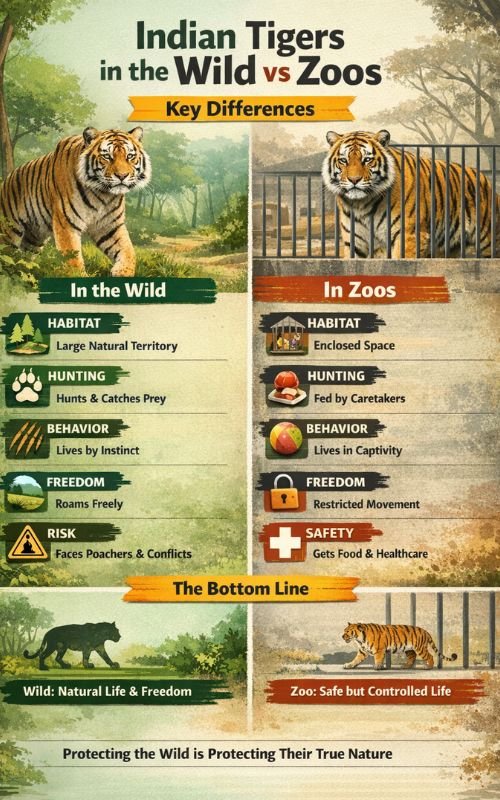
Wild vs. Captivity: The Biggest Differences
1. Freedom vs. Restriction
In the wild, a tiger can roam, choose, hide, hunt, and respond naturally. In a zoo, it lives within barriers and follows a controlled routine.
2. Hunting vs. Feeding
A wild tiger survives by hunting. A zoo tiger survives by being fed. One life depends on instinct. The other depends on human care.
3. Natural Behaviour vs. Managed Behaviour
In forests, tiger behaviour is active and meaningful. In captivity, some instincts become less useful because the environment is controlled.
4. Mental Stimulation vs. Repetition
The wild constantly challenges a tiger’s senses and decisions. Zoo life can become repetitive, even when the enclosure is well designed.
5. Risk vs. Safety
Wild tigers face real dangers like poaching, conflict, and habitat loss. Zoo tigers are safer in many ways, but that safety comes at the cost of independence.
Which Life Is Better for an Indian Tiger?
This question should be answered honestly and carefully.
If we only think about food, treatment, and physical protection, captivity may look better. A tiger in a zoo does not need to struggle daily for survival.
But if we think about freedom, natural behaviour, movement, hunting, mental stimulation, and ecological role, then the wild is clearly the better life for a tiger.
A tiger is not designed only to stay alive. It is designed to live as a powerful wild predator in a natural ecosystem.
So, while zoos may play a role in rescue, care, awareness, and conservation support, they cannot truly replace the wild home of a tiger.
Why Protecting Wild Tigers Matters Most
India’s tiger story is one of both success and warning. The country has made strong progress in tiger conservation, with official estimates showing a rise in tiger numbers, but the same official and conservation sources also make it clear that habitat fragmentation, conflict, and illegal pressures remain serious challenges.
This means the future of Indian tigers will not be secured by zoos alone. It will be secured by:
- protecting forests,
- keeping tiger corridors open,
- reducing human-wildlife conflict,
- stopping poaching,
- and maintaining healthy prey populations.
That is the real path of tiger conservation.
Conclusion
The difference between Indian tigers in the wild and Indian tigers in zoos is much bigger than people think.
In the wild, a tiger lives with freedom, challenge, instinct, and purpose. It hunts for food, moves across natural landscapes, and plays a real role in the ecosystem.
In captivity, a tiger may receive safety, food, and medical care, but it loses much of the independence and natural behaviour that make it truly wild.
So, the answer is simple: captivity may protect a tiger’s body, but the wild protects a tiger’s true nature.
Indian tigers do not belong only behind barriers. They belong in forests, where they can live fully, move freely, and remain what they were always meant to be — wild.
In the end, Indian tigers in the wild vs zoos is not just a comparison of place, but a comparison of how a tiger truly lives.
FAQ Section
Are Indian tigers safer in zoos than in the wild?
Yes, in many ways zoo tigers are safer because they get regular food, shelter, and medical care. But safety alone does not give them a natural life.
Why do tigers need large territories?
Tigers need large spaces for movement, hunting, mating, rest, and avoiding conflict. Habitat fragmentation is a major conservation concern.
Do zoo tigers hunt for food?
No, zoo tigers are usually fed by caretakers, so they do not hunt in the same natural way as wild tigers.
Why is the wild better for tigers?
The wild allows tigers to live according to their instincts, move freely, hunt naturally, and play their proper role in the ecosystem.